
Pyridoxal-d3 Hydrochloride
Stock Status: In Stock
Login to view price
Live
Added to RFQ
For Research & Analytical Purposes. Not for Personal use.
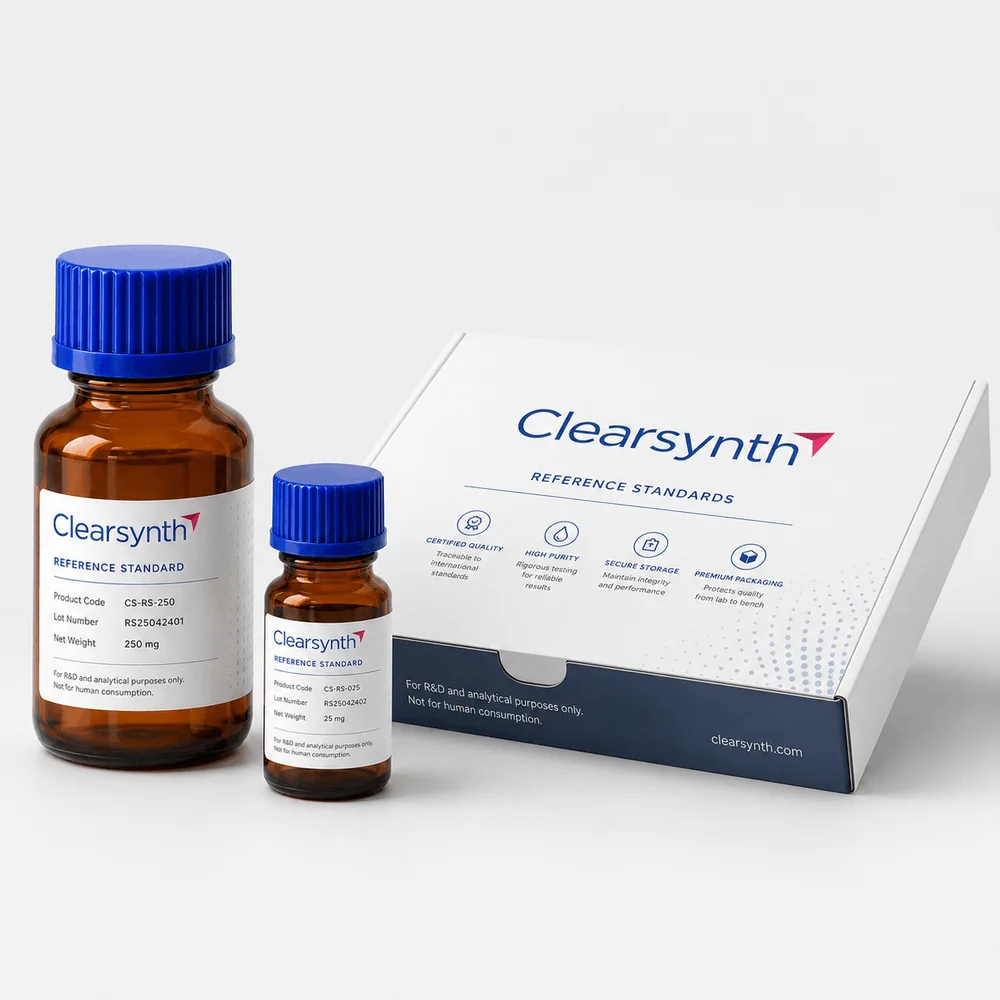
Packaging & Handling
Indicative product packaging is shown for visual reference. Actual packaging may vary based on pack size, quantity, storage condition and shipping requirements.
Documentation Available
Detailed specifications, certificates, and supporting documents are available upon request.
Detailed specifications, certificates, and supporting documents are available upon request.
Storage: Refer MSDS for complete information.
Hazard: Refer MSDS for accurate information.
Pyridoxal-d3 Hydrochloride Product Information
Pyridoxal-d3 Hydrochloride is listed under Stable Isotopes and is intended for analytical research, quality control and pharmaceutical reference standard applications. It is associated with Pyridoxal. The product is supplied by Clearsynth under CAT No. CS-T-60955.
Clearsynth provides this compound for research and analytical use, with product information including CAS number, molecular formula, molecular weight and product enquiry details.
Technical Data
Product Name
Pyridoxal-d3 Hydrochloride
CAS No.
1173023-49-8
CAT No.
CS-T-60955
HSN Code
38229010
Country of Origin
Can be shipped from India, Canada and USA
Molecular Formula
C8H7D3ClNO3
Molecular Weight
-
Category
API Family
Storage Condition
Refer MSDS for complete information.
Hazard Compound
Refer MSDS for accurate information.
Description
Regulatory Description
Pyridoxal-d3 Hydrochloride is supplied with detailed characterization data compliant with regulatory guideline. Pyridoxal-d3 Hydrochloride can be used for analytical method development, method validation (AMV), Quality Control (QC) application for Abbreviated New Drug Application (ANDA), or during commercial production of Pyridoxal.
Overview
"Isotope Labelled analogue of Pyridoxal , one of the three natural forms of vitamin B6, along with pyridoxamine and pyridoxine. All of these forms are converted in the human body into a single biologically active form, Pyridoxal 5-phosphate . Green plants are a natural source of Pyridoxal, and its deficiency in the human body can lead to serious complications such as epilepsy and seizures."
Synonyms
Pyridoxal-d3 Hydrochloride
Application Notes
"Isotope Labelled analogue of Pyridoxal , one of the three natural forms of vitamin B6, along with pyridoxamine and pyridoxine. All of these forms are converted in the human body into a single biologically active form, Pyridoxal 5-phosphate . Green plants are a natural source of Pyridoxal, and its deficiency in the human body can lead to serious complications such as epilepsy and seizures."
Product Applications & Regulatory Search Terms
Useful product, supplier and regulatory search terms for this reference standard.